

ChatGPT
Versatile multimodal AI assistant by OpenAI for drafting, data analysis, web search, and custom workflows.
NextBN helps you choose the right AI tool, follow step-by-step tutorials, and execute repeatable multi-tool workflows across writing, design, coding, research, and automation.
Start with the outcome you need to deliver and jump straight to the matching toolset or workflow.
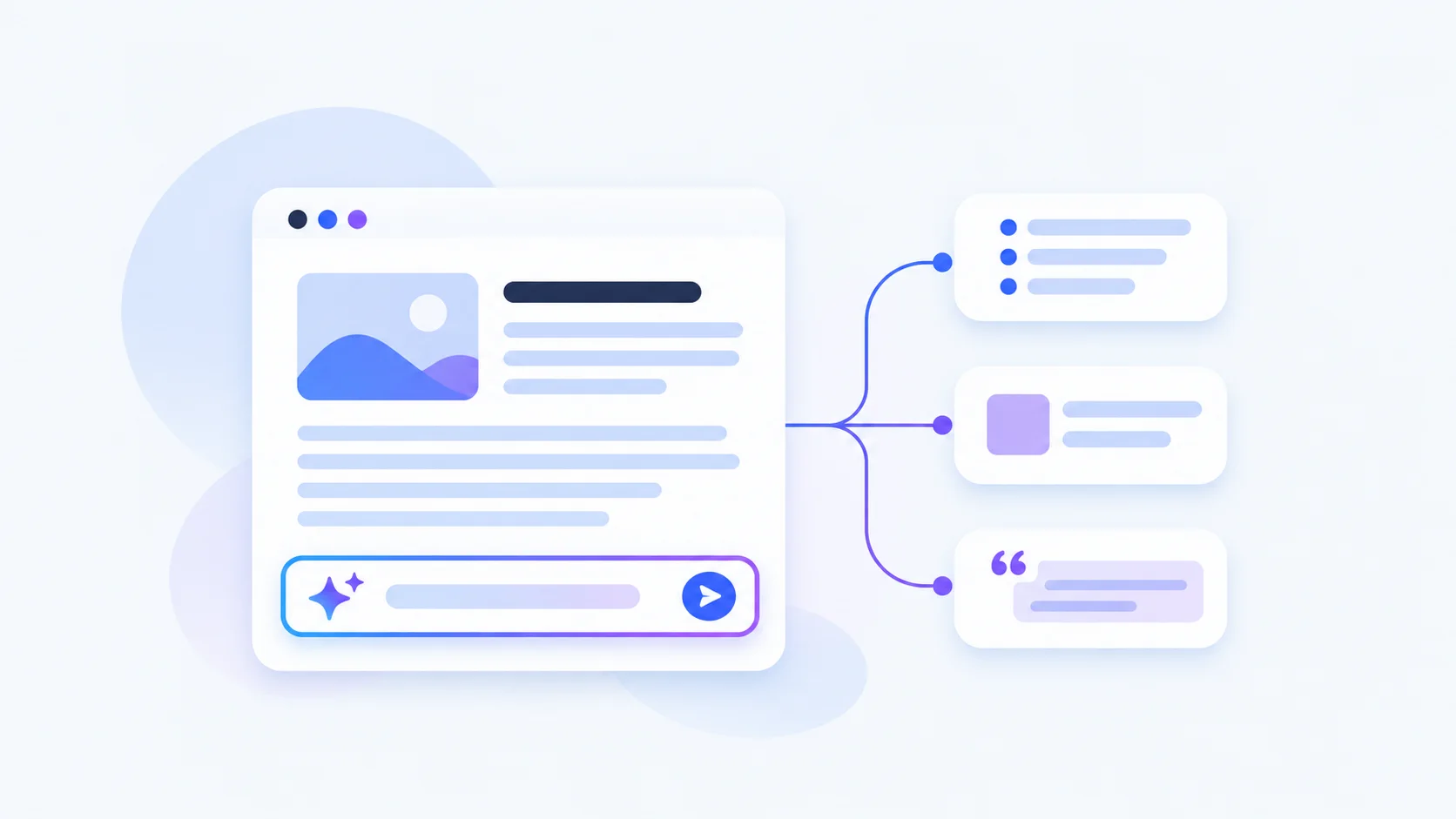
Draft articles, technical documentation, email sequences, and structured reports with long-context language models.
Generate concept art, editorial illustrations, and marketing visuals with aspect-ratio and style controls.
Produce short B-roll clips, animate storyboard frames, and repurpose long recordings into social cuts.
Synthesize multi-source literature, verify primary citations, and build structured comparison tables.
Chain research, drafting, and data extraction into repeatable multi-step pipelines with human checkpoints.
Deploy autonomous browser agents, coding assistants, and MCP tool connectors with scoped permissions.
Convert scripts into realistic narrated audio, localize voiceovers, and clean up spoken tracks.
Refactor multi-file repositories, generate unit tests, and organize daily workspace documentation.
Seven core software categories with verified tool profiles, real use cases, and filterable attributes.

Draft articles, structure long-form reports, refine tone, and edit technical documentation.

Generate concept visuals, editorial illustrations, product mockups, and style-consistent assets.

Create short motion clips, animate static storyboards, and repurpose long recordings into social cuts.

Synthesize natural voiceovers, narrate documentation, dub videos, and clean studio recordings.

Search live web sources with inline citations, synthesize PDFs, and compare technical documentation.

Organize workspace notes, summarize meetings, connect Google or Microsoft docs, and automate routine tasks.

Write, refactor, debug, and test software inside AI-native code editors and terminal assistants.
In-depth reviews of widely adopted AI platforms covering capabilities, workflow fit, pricing models, and limitations.
Versatile multimodal AI assistant by OpenAI for drafting, data analysis, web search, and custom workflows.
Anthropic’s AI assistant designed for nuanced long-form writing, large document analysis, and coding.
Google’s multimodal AI assistant connected with Google Workspace, Drive, Docs, and Search.
AI image generation platform for editorial illustration, concept visuals, and style-consistent art.
AI-native code editor built on VS Code with repository-wide indexing and multi-file refactoring.
Citation-backed AI answer engine that searches live web sources and synthesizes verifiable research briefs.
Creative AI video suite for generating motion clips, animating keyframes, and editing video timelines.
AI voice synthesis, narration studio, voice isolation, and multilingual dubbing platform.
Repeatable step-by-step pipelines showing how to chain research, drafting, visual, and audio tools together.
Turn a topic into a structured, fact-checked article using Perplexity for research, Claude for drafting, ChatGPT for table formatting, and Midjourney for header visuals.
Extract high-value segments from long interviews or webinars using Claude, generate visual b-roll in Runway, and polish audio with ElevenLabs.
Combine Perplexity’s live citation search with Claude’s large-context PDF analysis and Gemini’s Sheets export to build a verified research brief.
Turn a single published article or product guide into platform-native social posts, visual cards, and short audio/video snippets using Claude, ChatGPT, and Midjourney.
Hands-on tutorials with copyable prompt templates, common pitfalls, and quality checklists.

Learn how to configure ChatGPT, structure multi-step prompts, edit drafts in Canvas, and analyze uploaded files without generic outputs.

Follow a repeatable 7-step process to choose an image generator, structure visual prompts, control aspect ratios, and refine results for web publishing.

Learn how to plan a short storyboard, animate still keyframes in Runway, generate natural narration in ElevenLabs, and assemble a finished clip.

Build a reliable AI research process that separates live source discovery in Perplexity from document synthesis in Claude or Gemini.

Identify which repetitive tasks are safe to automate with AI, standardize input/output schemas, and build reliable human-in-the-loop workflows.

Replace vague one-liners with a practical 5-block prompt framework covering task objective, source material, negative constraints, and output format.
Side-by-side evaluations with feature matrices and scenario-based selection rules.
Choose ChatGPT if you want an all-in-one multimodal workspace with built-in web search, Python spreadsheet execution, and image generation. Choose Claude if your priority is natural long-form writing tone, large-document comprehension, and clean side-by-side code/document Artifacts.
Choose Midjourney if you want polished editorial illustrations, cohesive lighting, and zero hardware setup via a managed web interface. Choose Stable Diffusion (or open-weights workflows) if you require local execution on your own GPU, custom LoRA fine-tuning, and strict node-level control.
No single AI writing tool handles every stage of publishing equally well. Claude stands out for natural long-form drafting and style adherence, ChatGPT excels at interactive Canvas editing and data-backed tables, Gemini fits teams working inside Google Docs, and Perplexity serves as the essential research and citation layer before writing begins.
Effective AI video production relies on a modular stack rather than a single button: use Runway for controlled 5–10 second camera motion and browser cleanup, Midjourney to lock consistent starting keyframes, and ElevenLabs to generate natural spoken narration and multilingual dubbing.
Move beyond single-turn chat prompts. Learn how browser agents, repository-aware coding agents, no-code pipelines, and Model Context Protocol (MCP) connectors execute multi-step tasks with human guardrails.
Autonomous agents that navigate web pages, fill forms, extract structured tables, and execute multi-step browser tasks.
Multi-file software agents that read repositories, run terminal commands, execute test suites, and iterate on patches.
Visual agent builders that connect LLMs towebhooks, CRMs, spreadsheets, and email pipelines without custom backend code.
Standardized connectors and tool-calling servers that give AI assistants secure access to local files, databases, and APIs.
How autonomous research agents plan multi-query searches, verify primary citations, cross-check conflicting claims, and compile structured briefing documents.
A practical engineering guide to building reliable browser automation workflows using AI agents, DOM snapshots, and human-in-the-loop checkpoints.
Curated tool combinations and starter workflows tailored to specific professional roles.
Turn research outlines into long-form articles, generate custom visual assets, and repurpose video recordings across channels.
Build multi-channel campaign calendars, test ad creative variations, and track competitor positioning with cited sources.
Verify primary academic citations, compare methodology across uploaded PDFs, and organize literature matrices.
Navigate unfamiliar repositories, execute multi-file refactors, write unit test suites, and build MCP tool integrations.
Standardize operating procedures, automate recurring client reports, and streamline document review across Google Workspace.
Explore visual moodboards, test lighting and composition prompts, and convert static keyframes into motion sequences.
How NextBN evaluates AI tools, structures multi-step workflows, and maintains editorial independence.
Most directories list thousands of unverified links without explaining how they fit together. NextBN focuses on decision-making and execution: we pair curated AI tool reviews with multi-step workflows, copyable prompt templates, and side-by-side comparisons so you can complete real tasks.
No. Most workflows on NextBN can be executed using free tiers of major assistants such as ChatGPT, Claude, Gemini, and Perplexity. On every tool profile and workflow page, we clearly note whether a tool offers a free tier or requires a paid plan, and advise checking the vendor’s official website for current pricing.
We focus on established, widely documented AI platforms across writing, coding, research, image generation, video production, and voice synthesis. Each profile documents concrete strengths, real limitations, and scenarios where a tool is not the right fit.
An AI Guide teaches a core skill or methodology—such as how to structure prompts or how to verify research citations. An AI Workflow is a multi-step production blueprint that chains specific tools together (for example, Perplexity for research -> Claude for drafting -> Midjourney for visuals) to produce a finished deliverable.
Data privacy rules vary by vendor and subscription tier. Consumer free tiers often use conversations for model training unless opted out, whereas API, Team, and Enterprise plans typically exclude customer data from training. Always verify the vendor’s current privacy policy before uploading sensitive records.